Where to Source good quality Replacement Fuel Filters in China?
Fuel Filter Manufacturers in China, Grouped by Region Guangdong No. Manufacturer Location Relevant product range…
The best air purification filter depends on the pollutants you want to address and the system in which it will operate. Particle filters capture dust and pollen, while activated carbon helps reduce certain gases and odors. Combining these functions can provide broader filtration coverage.
These principles apply to both indoor air cleaning and vehicle cabin filtration, although the products have different dimensions, airflow requirements, and performance specifications. For automotive distributors and private label brands, choosing a cabin air filter means evaluating filtration performance alongside vehicle fitment, airflow resistance, and consistency across production batches.
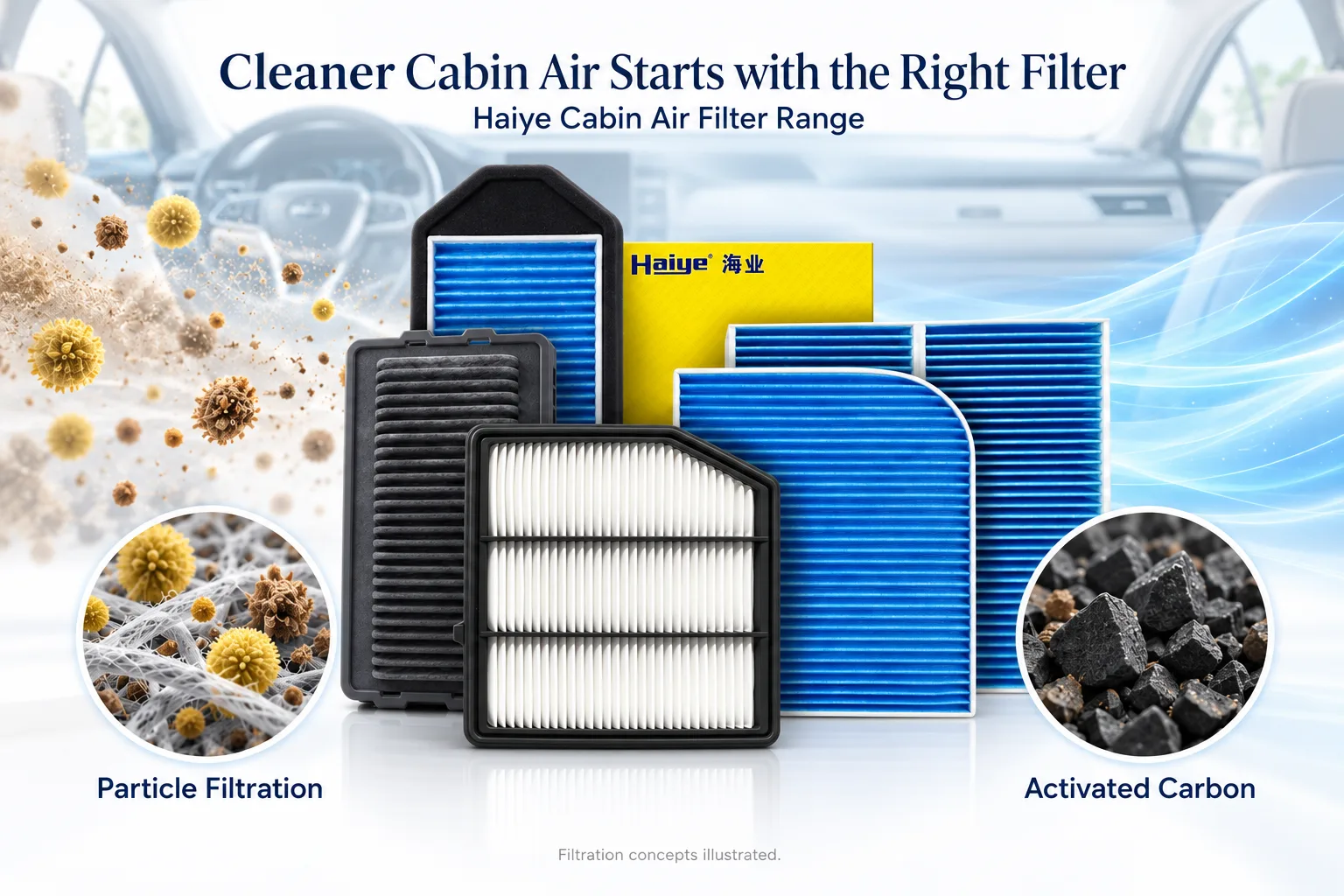
HEPA stands for High-Efficiency Particulate Air. Under the commonly cited US definition, a HEPA filter captures at least 99.97% of particles measuring 0.3 micrometers under specified conditions. This is a test reference size, rather than a minimum particle size the filter can capture. US EPA
HEPA media alone does not address gases or odors. Its efficiency also needs to be considered alongside airflow, sealing, and the capacity of the complete air-cleaning system. EPA
For automotive applications, buyers should request the exact cabin filter specification and applicable test results. A high-efficiency cabin filter should not automatically be described as HEPA, and household purifier ratings should not be transferred to automotive products. Contact Haiye for more HEPA filter options.
Activated carbon uses a porous structure to adsorb certain gaseous pollutants onto its surface. It complements particle filtration by addressing substances that ordinary particle media does not capture effectively. Haiye offers activated carbon cabin air filters for your private label brand, combining particle filtration with an activated carbon layer designed to help reduce selected gases and odors.
Activated carbon does not remove every gas equally. Its adsorption capacity is finite, and performance depends on the target pollutant, the amount of carbon, and operating conditions. It requires replacement when its useful capacity is exhausted. EPA
For cabin air filter sourcing, a dark-colored layer alone is insufficient evidence of odor-control performance. Buyers should evaluate the specified carbon construction and relevant product testing.
Electronic ionizers charge airborne particles, which may then attach to collection surfaces or other surfaces nearby. Electrostatic precipitators use charged collection plates. Haiye uses electrostatically charged filter media across its cabin air filter range to enhance airborne particle capture while maintaining airflow.
Maintenance and collection design affect performance. Some electronic air cleaners can also generate ozone, a lung irritant, so emissions need careful evaluation. A Technical Summary
Electret filter media is a different technology. It holds a charge within its fibers to support particle capture and does not require an operating ionizer. Buyers should distinguish charged filter media from powered electronic air-cleaning devices.
Composite filters combine layers with different functions. In automotive cabin filters, these may include particle-filtering media, an activated carbon layer, and application-specific functional materials.
Their main advantage is the ability to address more than one filtration requirement within a single replacement filter. However, adding layers can affect airflow resistance, thickness, and fitment. A suitable design balances these factors against the vehicle’s ventilation requirements.
| Filter option | Main function | Key buying consideration |
|---|---|---|
| HEPA filter | High-efficiency particle capture | Verified classification and complete system airflow |
| Activated carbon filter | Adsorption of selected gases and odors | Carbon quantity, target pollutants, and useful capacity |
| Electronic electrostatic cleaner | Electrically assisted particle collection | Collection efficiency, cleaning needs, and ozone emissions |
| Electret particle media | Particle capture supported by charged fibers | Efficiency and pressure drop under relevant conditions |
| Composite cabin filter | Combined particle filtration and additional functions | Vehicle fitment, airflow, and evidence for each claimed function |
For household air purifiers, choose a unit with a particle Clean Air Delivery Rate, or CADR, appropriate for the room. CADR measures particle-cleaning performance; it does not establish gas-removal performance. US EPA
For automotive cabin filters, focus on the correct application, dimensions, sealing, filtration efficiency, and airflow resistance.
For distributors, importers, and private label brands, the value of a cabin air filter extends beyond the first sample. Repeat orders need to follow agreed material, construction, and packaging requirements.
Haiye’s cabin filter offering supports this buying process through product options, manufacturing controls, and OEM project coordination.
Haiye offers particle-filtering, activated carbon, and functional composite cabin filter options. These allow buyers to develop different product tiers according to their target market and agreed technical requirements.
A particle-filtering option can focus on dust and pollen capture. An activated carbon option adds a layer intended for selected odor and gas adsorption. Functional composite options require evaluation against the specific performance claims proposed for that product.
Haiye evaluates filter media options against the intended application, filtration targets, airflow requirements, and manufacturing needs.
This helps buyers define a product specification that reflects how the filter will be used. Material selection should also consider pleat stability, bonding, and the available installation space.
Haiye’s quality-control approach includes incoming material inspection, checks during production, and finished-product inspection.
For cabin air filters, relevant checks include:
These controls help maintain production against approved requirements and support more consistent repeat orders.
Haiye supports OEM and private label projects through agreed product specifications and project-dependent branding, labeling, and packaging options.
For customized projects, confirming technical requirements and approving samples before mass production helps align expectations. Customer artwork and logos are used with appropriate brand authorization.
Performance claims should be supported by evidence for the relevant product or material. Buyers should assess filtration efficiency, pressure drop, gas adsorption, or functional treatment results separately.
A laboratory result for one material does not automatically establish the performance of every finished cabin filter. Matching the evidence to the supplied specification makes product positioning more credible.
Start with the vehicle application and OE reference, then define your target performance and product positioning.
Before approving a supplier or specification, review:
Maintenance also matters. Follow the vehicle manufacturer’s replacement guidance and consider operating conditions when assessing filter condition.
Selecting an automotive cabin air filter means balancing particle capture, odor-control requirements, airflow, and fitment.
Send Haiye your OE references, target quantities, market positioning, and performance requirements to discuss suitable cabin air filter options for your OEM or private label project.